
Medically Reviewed by Dr. Catherine Murphy, DDS, MSD on September 28, 2026
Invisalign is an effective option for mild to moderate alignment issues because its digitally planned, incremental tray system can predictably correct crowding, spacing, and many bite concerns without the extractions or hardware that more complex cases sometimes require. If your teeth are slightly crowded, mildly spaced, or just a little off-kilter, you may be closer to your ideal smile than you think.
At Floss & Co., our team takes a personalized approach to every Invisalign consultation, factoring in not just the alignment of your teeth but your overall oral health and comfort goals. As part of our comprehensive orthodontic services, we work closely with each patient to determine whether Invisalign is the right fit for your case.
How Invisalign Works for Mild to Moderate Cases
Invisalign uses a series of custom-fabricated, removable clear aligners to shift teeth gradually into better positions. Each set of aligners is worn for about one to two weeks before progressing to the next, with each tray moving teeth in small, carefully planned increments. The system relies on digital imaging and 3D modeling to map out the entire course of treatment before the first aligner is ever placed in your mouth.
This level of planning is part of why Invisalign tends to perform especially well for mild to moderate alignment concerns. A systematic review of Invisalign’s clinical effectiveness, indexed by the National Library of Medicine, found substantial consistency across studies that the system is a viable alternative to conventional orthodontic therapy for mild to moderate malocclusions in patients who are no longer growing and do not need extractions. The same review noted that larger bite discrepancies were harder to correct with aligners alone, which is why an accurate diagnosis matters before treatment begins.
What Causes Mild to Moderate Alignment Issues?
Crowding and spacing usually come down to a mismatch between the size of your jaw and the size of your teeth. When there is not quite enough room along the arch, teeth can overlap, twist, or tilt out of position. Genetics play a large role, but early tooth loss, prolonged thumb sucking, or a tongue-thrust habit during childhood can also contribute to how teeth eventually settle into place.
Spacing works in the opposite direction. A jaw that is slightly larger than your teeth require, a missing tooth, or a prominent labial frenum can all leave visible gaps. Left unaddressed, both crowding and spacing can make brushing and flossing more difficult, which is one of the practical reasons patients often decide to move forward with treatment beyond the cosmetic benefit alone.
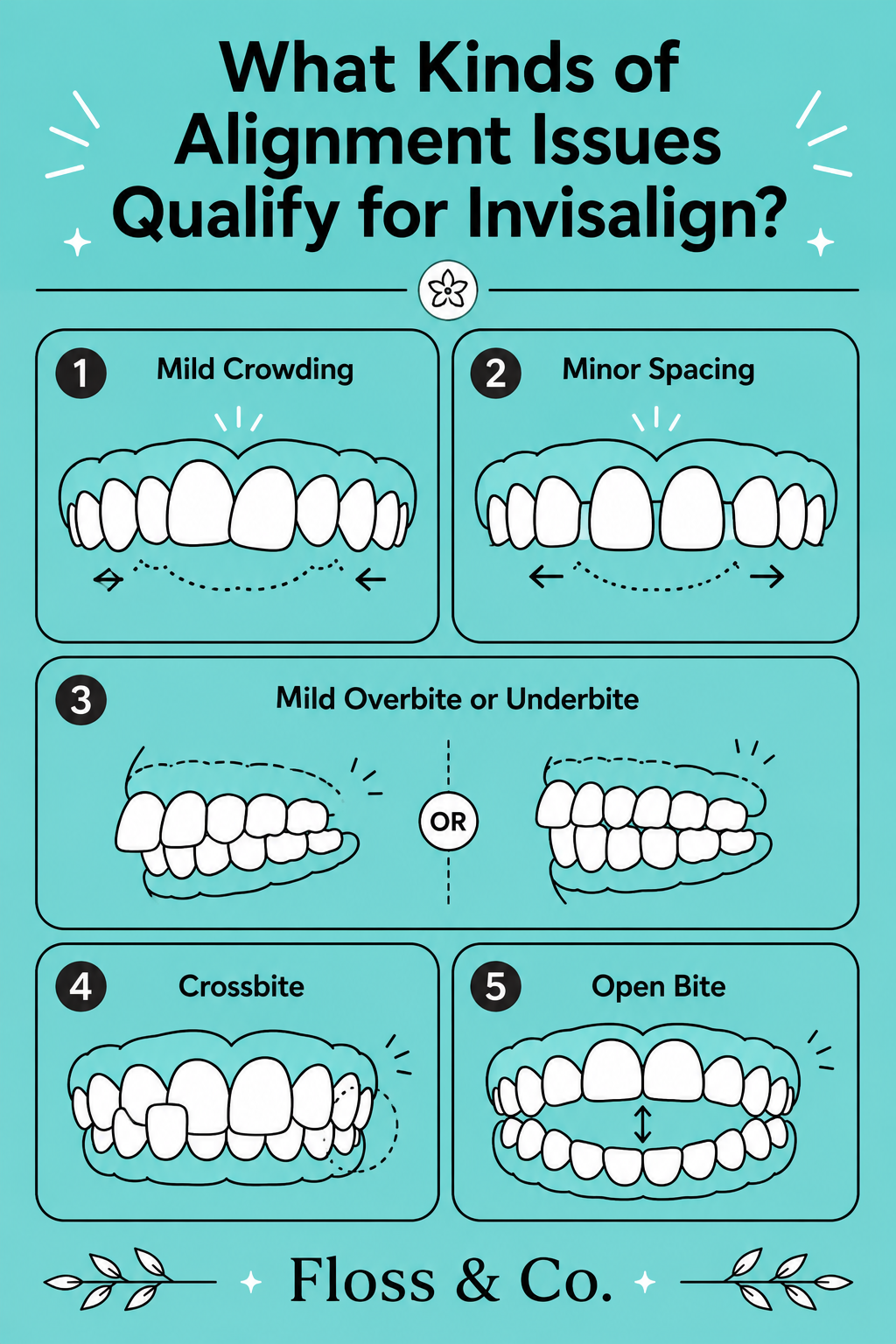
What Kinds of Alignment Issues Qualify for Invisalign?
Not every orthodontic case is the same, and Invisalign is not a one-size-fits-all solution. However, a wide range of common concerns fall well within the treatment range that clear aligners handle effectively.
Some of the alignment issues that Invisalign often addresses well include:
- Mild crowding: Teeth that are slightly overlapping or shifted out of position due to limited arch space
- Minor spacing: Small gaps between teeth that affect both appearance and function
- Mild overbite or underbite: Cases where the upper or lower teeth extend slightly beyond their ideal position
- Crossbite: Situations where some upper teeth sit behind lower teeth, causing uneven wear
- Open bite: A minor separation between upper and lower teeth when the mouth is closed
Each of these concerns is assessed individually during a consultation, because the severity of the issue determines whether Invisalign alone is the most appropriate approach or whether a combination of treatments may serve you better.
The Invisalign Treatment Process, Step by Step
Knowing what treatment actually involves can make the decision to move forward feel far less uncertain. Here is what the process generally looks like from the first visit to your final retainer. If you want even more detail on the first visit, our post on what to expect during your first orthodontic consultation covers it step by step.
Your Initial Consultation
Every Invisalign case starts with an evaluation of your teeth, bite, and jaw function, along with a conversation about your goals and concerns. This is also when we determine whether your case falls within the mild to moderate range that aligners handle predictably or whether a combination approach might serve you better.
Digital Planning and Aligner Fabrication
Once we confirm Invisalign is a good fit, we take a digital scan of your teeth rather than a traditional impression. That scan feeds into software that maps out each incremental movement of your treatment, so you can see a simulation of your projected results before your aligners are ever fabricated.
Wearing and Changing Your Aligners
Aligners are typically worn 20 to 22 hours a day and removed only for eating, drinking anything other than water, and oral hygiene. Most patients switch to a new set every one to two weeks, with each tray making small, incremental adjustments that add up over the course of treatment. Mild pressure with each new set is normal and usually eases within a day or two.
Progress Checks and Retainers
Periodic check-ins with our team confirm that your teeth are tracking as planned, and adjustments to your treatment plan can be made if needed. Once your active treatment is complete, wearing one of our retainers is an important part of protecting your results, since teeth can drift back toward their original position without one.
The Everyday Advantages of Choosing Clear Aligners
Beyond clinical effectiveness, many patients who choose clear aligners appreciate how naturally the treatment fits into their daily routine. Because the trays are removable, there are no restrictions on what you eat or how you clean your teeth, two common frustrations for patients in traditional braces.
Discretion and Comfort
The clear material makes Invisalign nearly invisible in social and professional settings, which is one of the biggest draws for adult orthodontic patients who want to improve their smile without advertising the process. The smooth plastic also tends to be gentler on the soft tissue inside the mouth, eliminating much of the irritation that brackets and wires can cause.
Predictability and Planning
Because the entire treatment arc is mapped digitally before treatment begins, patients can see a simulation of their projected results before committing to the process. This transparency is something many patients find reassuring, particularly those who want a clear sense of what to expect and how long treatment will take.
When Invisalign and Braces Work Together
In some cases, a combination approach may produce the best outcome. For patients whose alignment issues sit at the moderate end of the spectrum, or who have specific movement goals that benefit from more traditional mechanics, braces and clear aligners are not mutually exclusive options. The right path depends entirely on what your teeth need and what fits your lifestyle.
The comparison below shows how the two options generally differ for mild to moderate cases.
| Factor | Invisalign | Braces |
|---|---|---|
| Appearance | Clear, nearly invisible trays | Visible brackets, with ceramic options available |
| Eating and cleaning | Remove trays to eat, brush, and floss | Some food limits, cleaning around wires |
| Daily commitment | Worn 20 to 22 hours a day | Fixed in place, no daily wear decisions |
| Best suited for | Mild to moderate crowding, spacing, and bite concerns | Mild through complex cases, including larger bite corrections |
Our team evaluates each case with care, taking into account not just tooth position but the health of your bite, jaw function, and long-term stability. Our orthodontic consultations include airway assessments, meaning your treatment plan considers more than just how your teeth look.
Choose Floss & Co. for Your Invisalign Consultation
At Floss & Co., Dr. Murphy and Dr. Silva bring thoughtful, patient-centered care to every orthodontic case. Dr. Murphy completed her orthodontic residency at Indiana University School of Dentistry and takes a holistic approach to orthodontics, with a strong belief in expansion over extraction. Dr. Silva is an Invisalign Certified Provider and a Fellow of the Academy of General Dentistry, bringing a broad clinical perspective to how our team evaluates alignment and overall oral health.
If you are curious whether Invisalign is the right fit for your alignment concerns, we would love to talk. Reach out to us to schedule a consultation and take the first step toward a smile that works better for you.
Frequently Asked Questions About Invisalign for Mild to Moderate Alignment
What causes teeth to become crowded or spaced apart?
Crowding typically happens when the jaw does not have enough room for all of your teeth, often due to genetics, early loss of baby teeth, or childhood habits such as thumb sucking. Spacing tends to happen for the opposite reason, when the jaw is slightly larger than the teeth require or a tooth is missing, leaving visible gaps between teeth.
How long does Invisalign treatment typically take for mild to moderate cases?
Treatment length depends on the complexity of your case, but mild to moderate crowding or spacing often moves more quickly than cases requiring significant tooth movement. Your treatment plan will include an estimated timeline based on your digital scan, and progress checks along the way confirm that your teeth are tracking as planned.
What happens if my teeth do not track properly with my aligners?
If a tray stops fitting precisely, our team may recommend a refinement, which is a new set of aligners based on an updated scan of your current tooth position. This is a normal part of many treatment plans and allows your care to adjust to how your teeth are actually responding rather than only the original projection.
Do I need to wear a retainer after finishing Invisalign?
Yes. Teeth can drift back toward their original position once active treatment ends, so wearing a retainer as directed by our team is an important part of protecting the results you worked toward. Retainer schedules vary by patient, and we will walk you through what to expect for your specific case.
Can Invisalign correct a crossbite or open bite on its own?
Invisalign can often address mild to moderate crossbites and open bites through careful tooth repositioning, sometimes with the help of attachments or elastics. More significant bite discrepancies related to jaw size or position may need a different approach, which is why a full evaluation during your consultation matters before starting treatment.
About the Author
Dr. Catherine Murphy, DDS, MSD
Orthodontist, Floss & Co.
Dr. Catherine Murphy earned her Doctor of Dental Surgery from Indiana University School of Dentistry and her Master of Science in Dentistry through an orthodontic residency at the same institution. She brings a holistic, whole-patient approach to orthodontic care, with a focus on expansion over extraction.