
Medically Reviewed by Dr. Izzy Naem, DDS on September 28, 2026
An in-house dental lab matters for implant treatment because the quality and fit of your final crown, bridge, or prosthesis depend on how closely the people designing it can work with the dentist who placed your implant. When fabrication stays under the same roof as your surgical and restorative care, your restoration can be designed around your exact implant position, checked against your real bite, and refined in person before it is finalized.
At Floss & Co., we are proud to offer dental implant treatment supported by our in-house dental lab, giving our team direct control over how every implant restoration is shaped, shaded, and seated. This post focuses on quality and fit. If your main question is how long treatment takes, our companion post on how an in-house lab speeds up the implant process walks through the timeline stage by stage.
What Is an In-House Dental Lab?
An in-house dental lab is a laboratory within a dental practice that fabricates restorations such as crowns, bridges, and implant-supported prostheses on-site. In most traditional practices, after an implant is placed, impressions or scans are sent to an outside facility, sometimes hundreds of miles away, to have the crown or prosthetic component made.
The outside lab works from that file and a written prescription, then ships the finished piece back. With an in-house lab, that entire process stays within our walls, giving our team direct oversight of every step from planning through delivery, and giving the technician access to the dentist and the patient when a question comes up.
What a Good Fit Means for an Implant Restoration
A natural tooth has a ligament that cushions it slightly. An implant is fused directly to bone, so the crown on top of it has very little room for error. When our team talks about fit, we are looking at several details at once, and each one affects how the restoration feels, functions, and holds up over time.
An outside lab can do excellent work on all of these points, but it has to rely on a scan, a model, and notes. An in-house lab lets the technician confirm those details against the real mouth and the real implant components, which is where much of the practical advantage comes from.
How an In-House Lab Improves Implant Quality and Fit
Having your restoration fabricated on-site creates advantages at every stage of implant care, from the first digital scan to the final adjustment appointment.
Better Communication Between the Lab and Your Dentist
When the lab and the dental chair are in the same building, the people fabricating your restoration can communicate with our dentists in real time. That direct collaboration matters when fine-tuning the shape, shade, and fit of a crown or prosthetic component. Rather than relying on written notes and photographs sent to a distant technician, our team can consult immediately and make adjustments with precision.
Small details, like how a crown interacts with your bite or how its contours align with neighboring teeth, are far easier to perfect when everyone is working together in the same space. The result is a restoration that looks, feels, and functions like a natural part of your smile rather than a generic solution.
A Digital Workflow From Scan to Restoration
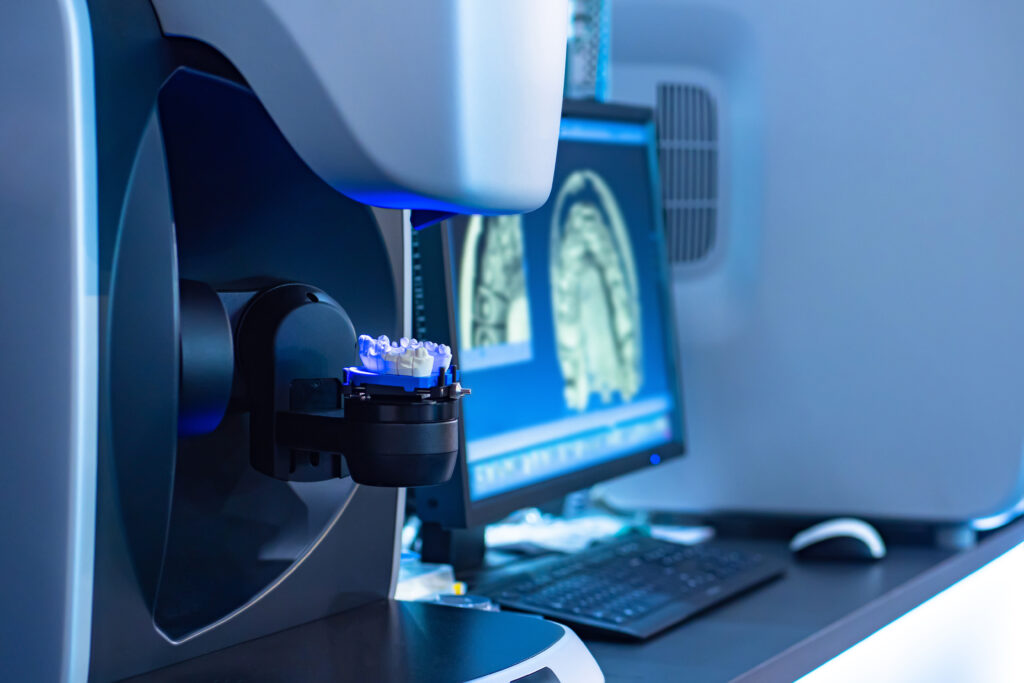
Our implant restorations begin with a digital scan rather than traditional impression material, and that file moves directly to the people designing your crown. A 2024 randomized controlled trial comparing digital and conventional workflows for implant restorations found that the fully digital approach produced better contact with neighboring and opposing teeth, a shorter impression time, and higher patient satisfaction, while the fit between implant and abutment was similar across methods.
That last point is worth being honest about. Digital tools alone do not guarantee a better result. The benefit comes from pairing an accurate digital file with a technician who can check the design against your actual bite and adjust it before the restoration is finalized, which is exactly what an on-site lab makes possible.
Fewer Hand-Offs, Better Outcomes for Full-Arch Cases
For patients exploring more extensive restorations, in-house lab capabilities make an especially meaningful difference. All-on-X implants require a high degree of coordination between surgical placement and prosthetic design. When both elements are managed within the same practice, treatment planning is more cohesive.
Fewer transitions between outside parties means fewer opportunities for miscommunication and a more predictable path to a fully restored smile. Patients who need full-arch work benefit from this kind of integrated approach, where the team guiding the guided implant surgery is the same team overseeing the prosthetic placement.
Quality Control You Can See
Direct oversight of the fabrication process means every restoration we produce is checked against our own clinical standards before it ever reaches your mouth. Because our technicians work exclusively with our team’s protocols, the materials, shade matching, and fit stay consistent from one case to the next rather than varying with whichever outside lab happened to receive the file.
Multiple checkpoints throughout fabrication help catch potential issues early, which can reduce the likelihood of a remake or an extra adjustment appointment after placement. It also means the materials used in your crown or bridge are selected and controlled by our own team rather than an outside vendor’s inventory.
The table below summarizes where the two approaches tend to differ on quality and fit.
| Quality Factor | In-House Lab | Outside Lab |
|---|---|---|
| Dentist and technician communication | Face to face, during treatment | Written prescription, photos, and calls |
| Shade matching | Technician can see your teeth in person | Based on shade tabs and photographs |
| Fit and bite adjustments | Refined on-site, often the same day | Sent back to the lab for changes |
| Materials | Selected and stocked by our team | Chosen from the lab’s own inventory |
| Consistency across cases | Same technicians and protocols every time | Can vary by lab and technician |
For patients who have previously experienced an ill-fitting crown or a restoration that never quite matched the surrounding teeth, this level of oversight often makes the biggest difference. Consistency at every checkpoint reduces the number of surprises between your consultation and your final appointment.
The Technology Behind Our In-House Lab
Our team uses digital scanning in place of traditional impression material, along with CAD/CAM design and milling technology, the same tools behind our same-day crowns and bridges. This digital workflow connects directly to the treatment planning used during your implant placement, so the final restoration is designed with your specific implant position, bite, and surrounding teeth in mind from the very beginning.
Because equipment, materials, and scheduling all stay in-house, we can also avoid the shipping fees and outside markups that come with sending work to a remote laboratory, which supports more predictable overall treatment costs. For a closer look at the precision side of this process, see our post on the role our in-house lab plays in implant accuracy.
A More Personalized Restoration
Having a lab on-site allows you to be part of the process in a way that is simply not possible when your case is sent elsewhere. You can discuss shade, shape, and fit directly with the people creating your restoration, and our technicians can make same-day adjustments if something needs a closer look before your final appointment.
This kind of hands-on involvement is especially valuable for visible restorations near the front of the smile, where small differences in color or contour make a noticeable difference in how natural the final result looks. Patients who have unique anatomy, an unusual bite pattern, or specific aesthetic goals also benefit from a technician who can revisit a restoration in person rather than relying on written notes sent back and forth with an outside facility.
Over time, this ongoing relationship between our clinical team and our lab technicians builds a level of familiarity that supports better long-term maintenance of your restoration as well, since the same people who created it are the ones you will see for adjustments down the road.
Questions to Ask About Your Implant Restoration
Whether you are replacing one tooth with a single tooth implant or planning a full-arch case, a few questions can help you understand how your restoration will be made and checked:
- Who designs the restoration: Is it made on-site or sent to an outside lab?
- How shade is chosen: Will the technician see your natural teeth in person?
- How fit is verified: What happens if the bite or contacts need adjustment?
- What material is used: Why is that material the right choice for this tooth?
Our team is happy to answer each of these during your consultation, so you know exactly how your restoration will be designed, fabricated, and fitted.
Choose Floss & Co. for Your Implant Treatment in Chicago
At Floss & Co., our in-house lab is one of the ways we bring careful, coordinated care directly to our patients in the Chicago area and surrounding communities. Dr. Martha Silva, Dr. Catherine Murphy, Dr. Izzy Naem, Dr. Delone Jouja, and our clinical team are committed to a treatment experience that prioritizes precision, efficiency, and outcomes that genuinely improve your quality of life. We also offer flexible financing options, including CareCredit, making it easier to move forward with the care you need.
If you are ready to learn whether restorative dentistry with an in-house lab is right for you, we would love to be part of that conversation. Contact us to schedule a consultation and take the first step toward a smile that is built to last.
Frequently Asked Questions About Our In-House Dental Lab
How much faster is treatment with an in-house dental lab?
Timelines vary by case, but keeping fabrication on-site removes the days or weeks that shipping to an outside lab typically adds. Some adjustments that would otherwise require a new appointment can be completed the same day, since the technician and dentist are working in the same building. Healing time after implant placement is biological and does not change.
Does an in-house lab affect the cost of dental implant treatment?
An in-house lab can help offset some of the shipping, handling, and outside markup fees associated with outsourced fabrication. Total cost still depends on the number of implants, the type of restoration, and your specific treatment plan, which our team reviews with you in detail during your consultation.
Can an in-house lab match the quality of an outside specialty lab?
Quality depends on the skill of the technician, the materials, and the equipment, whether a lab is on-site or not. Our lab uses digital scanning and CAD/CAM design and milling, and it adds something an outside lab cannot offer: direct, real-time collaboration between the technician and your treating dentist throughout fabrication.
What happens if my implant crown does not feel right?
Let our team know right away. A crown that feels high, catches food, or looks off in color can often be adjusted or refined on-site because the people who made it work in the same building. Addressing bite or contact issues early helps protect the implant and the surrounding teeth over time.
Is an in-house lab helpful for full-arch or All-on-X implant cases?
Full-arch cases benefit significantly from in-house lab coordination, since the surgical and prosthetic teams can plan implant position and final restoration design together rather than handing the case off to a separate outside facility partway through treatment.
Will I be able to see my restoration before it is finished?
In many cases, yes. Because fabrication happens on-site, our team can review shade, shape, and fit with you during the process and make same-day adjustments before your restoration is finalized and placed.
About the Author
Dentist, Floss & Co.
Dr. Izzy Naem earned his dental doctorate from the University of Detroit Mercy Dental School and holds diplomate status with both the International Dental Implant Association and the American Dental Implant Association. He has completed extensive continuing education in dental implants and complex restorative care.