
Most people know the basics: teeth come in, fall out, and grow back. What’s less commonly understood is that this process follows a precise biological timeline that begins months before your first tooth ever breaks through the gum line. Understanding each stage of tooth development can help you protect your smile at every age and catch potential problems before they become serious.
At Floss & Co., our team takes a whole-mouth approach to care, which means we’re as invested in the health of your developing teeth as we are in treating issues that arise later. From your first baby tooth to your last permanent molar, there’s a lot happening beneath the surface, and knowing what to expect makes a real difference in how you care for your smile over time.
How Teeth Develop Before You’re Even Born
Tooth development begins in the embryonic stage, around three to six weeks after conception, when soft tissue forms the earliest tooth structures. By three to four months of prenatal development, hard tissue starts forming around those structures, and thin roots begin to grow. By birth, 20 fully developed primary teeth are already buried under the gums, waiting to erupt. In some rare cases, babies are born with a partially erupted tooth, though this is uncommon.
The eruption timeline for baby teeth varies from child to child. The lower central incisors are typically the first to appear, usually between three and six months. They’re followed by the upper central incisors, then the upper and lower lateral incisors, the first molars, the canines, and finally the second molars, all arriving by around age two or three. Since every child develops at a different pace, slight variations in timing are completely normal.
When Baby Teeth Make Way for Permanent Teeth
As a child grows, the brain sends specialized cells to break down the roots of baby teeth from beneath, which is what causes them to loosen and fall out. At the same time, the permanent teeth are slowly pushing upward to take their place. Baby teeth tend to fall out in roughly the same order they arrived, but permanent teeth follow a more varied pattern.
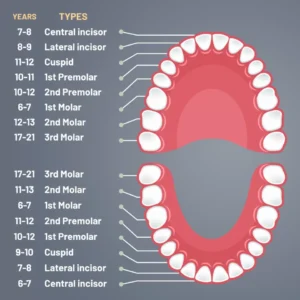
Permanent teeth begin arriving around age six, starting with the central incisors. Lateral incisors typically follow between ages seven and nine, with canines, premolars, and molars appearing through the mid-teens. The second molars usually come in between ages eleven and thirteen, and wisdom teeth typically erupt between the late teens and early twenties, though many require monitoring or removal due to crowding.
When Do Teeth Stop Growing?
Teeth stop growing in height once they fully erupt through the gum line, which is complete for most permanent teeth by age 21. Root development continues for one to three years after a tooth erupts — for example, first permanent molars erupt around age six but their roots finish forming by approximately age nine or ten. Wisdom teeth, the last permanent teeth to arrive, typically complete root formation between ages 18 and 25. After that point, no additional tooth growth occurs. Teeth do not get larger or longer with age; any appearance of longer teeth in adulthood is caused by gum recession exposing more of the tooth root, not by the tooth itself growing.
Do Molars Fall Out and Grow Back?
No — adult molars do not fall out and grow back. Once permanent molars erupt, they are not replaced by a third set of teeth. Baby molars (primary second molars) do fall out around ages 10 to 12, but the teeth that replace them are premolars, not molars. The six-year molars and twelve-year molars that erupt directly behind the baby teeth are permanent from the start and have no successor teeth. Only wisdom teeth, or third molars, arrive after the twelve-year molars, and they do not regrow if removed. Adult molar loss due to decay, gum disease, or trauma is permanent, which makes protecting these teeth with consistent care and regular exams essential.
How Do Teeth Grow?
Teeth grow through a process called tooth eruption, in which the developing tooth crown pushes upward through the jawbone and gum tissue until it reaches its functional position in the mouth. This process is driven by root elongation — as the root grows downward, it pushes the crown upward. Tooth development begins long before eruption: enamel and dentin form around a soft tissue core called the dental pulp, starting in the embryonic stage. By the time a tooth becomes visible in the mouth, its crown is fully formed. The root continues developing for one to three years after the crown erupts, anchoring the tooth securely in the jawbone through a network of fibers called the periodontal ligament.
How Long Does It Take for Teeth to Grow Back After Falling Out?
When a baby tooth falls out, the permanent tooth replacing it typically takes one to two months to begin visibly erupting, though the full emergence process can take six months to a year. Incisors and canines, which have a single root, tend to erupt faster than molars, which have multiple roots and a broader eruption path. If a baby tooth falls out earlier than expected due to decay or injury, the permanent tooth does not necessarily erupt sooner — it follows its own developmental timeline. Adult teeth do not grow back after loss under any circumstances, as humans are biologically limited to two sets of teeth.
What Causes Permanent Teeth to Shift or Fall Out
Once your permanent teeth are in, they’re built to last a lifetime. However, several common factors can threaten that longevity. According to the National Institute of Dental and Craniofacial Research, periodontal disease is the leading cause of tooth loss in adults, making consistent professional dental care essential at every stage of life.
Gum disease begins as gingivitis, which causes redness and irritation but can still be reversed with professional care. Left untreated, it progresses into periodontitis, where the gums pull away from the teeth, harmful bacteria form in the resulting pockets, and bone loss begins. In its most advanced stages, there is no longer enough bone or tissue to support the tooth, leading to loss that affects both appearance and overall health. Tooth decay is another major contributor. When bacterial infection reaches the root of a tooth, root canal treatment is often the best option for saving it. If the tooth cannot be saved, extraction becomes necessary. Everyday habits like using teeth to open packaging or chew ice can also cause unexpected fractures and trauma that put permanent teeth at risk.
Options for Replacing Missing Teeth
Losing a permanent tooth doesn’t mean accepting a gap in your smile. Several reliable tooth replacement options can restore both function and appearance. Dental implants are the current standard of care for missing teeth, using a titanium post placed directly in the jawbone to support a natural-looking crown. They function like real teeth, preserve the surrounding bone, and can even support dentures for a more secure fit. Floss & Co. also operates an in-house lab for implant procedures, which means greater precision and efficiency from start to finish.
Dental bridges offer another path forward, where two crowns anchor a false tooth in between to fill the space left by a missing tooth. For patients missing multiple teeth, dentures have advanced considerably over the past several decades, with modern options that are comfortable, natural-looking, and can be permanently anchored with implants for added stability. The best solution depends on your individual situation, and a consultation is the best way to explore what fits your needs.
Sometimes permanent teeth can also grow in crooked or misaligned, which is where braces and other alignment treatments come in. Early intervention can address crowding, jaw positioning, and even airway function before issues compound over time.
Trust Floss & Co. to Support Your Smile at Every Stage
Understanding the life cycle of your teeth is the first step toward protecting them for the long haul. Whether you’re tracking your child’s development, navigating a concern of your own, or exploring options after tooth loss, consistent dental care is what keeps every stage of that journey on track.
At Floss & Co., our team provides comprehensive dental care for patients of all ages, from early childhood through adulthood, in a welcoming environment inclusive of everyone. We combine state-of-the-art technology with a genuine commitment to patient comfort to give your smile the care it deserves at every age. Reach out today through our contact form to schedule your appointment and take the next step toward a healthier, lasting smile.